managing low level concerns policy
Issue Date : December 2025
Reviewed By: Full Governing Board
Review Date: December 2027
Introduction
The statutory guidance, Keeping Children Safe in Education (KCSiE) 2025 includes guidance for schools and trusts on dealing with low-level concerns about the behaviour of staff working with children.
The purpose of this guidance policy is to create and embed a culture of openness, trust, and transparency in which the clear values and expected behaviour are reinforced to all staff, including supply teachers, volunteers, and contractors, as set out in the staff Code of Conduct.
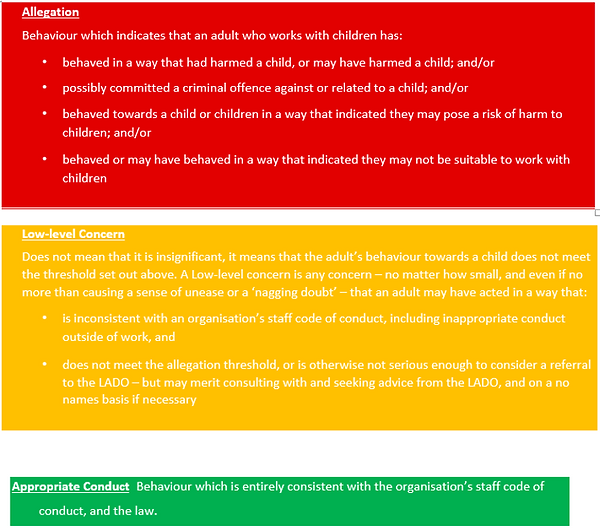
This guidance covers low-level concerns that do not meet the harm threshold. An allegation may meet the harm threshold where it is alleged that a person who works with children has:
-
behaved in a way that has harmed a child or may have harmed a child.
-
possibly committed a criminal offence against or related to a child.
-
behaved towards a child or children in a way that indicates they may pose a risk of harm to children.
-
behaved or may have behaved in a way that indicates they may not be suitable to work with children.
Allegations that may meet the harm threshold should be assessed accordingly and advice should be sought from the Local Authority Designated Officer (LADO) and/or HR Services.
This guidance should be used in conjunction with the Federations’ Code of Conduct, Disciplinary and Child Protection Policy, and Procedures.
1. What is a low-level concern?
The term ‘low-level’ concern does not mean that it is insignificant, it means that the behaviour towards a child does not meet the prescribed threshold. A low-level concern is any concern – no matter how small, even if it is just causing a sense of unease or a ‘nagging doubt’ - that an adult working in or on behalf of the organisation may have acted in a way that:
-
is inconsistent with the staff Code of Conduct, including inappropriate conduct outside of work.
-
is a cause for concern but does not meet the threshold of harm or is not considered serious enough to refer to the LADO.
Low-level concerns are part of a spectrum of behaviour including inadvertent or thoughtless behaviour; behaviour that might be considered inappropriate depending on the circumstances; and/or behaviour which is intended to enable abuse.
Examples of such behaviour could include, but are not limited to:
-
being over friendly with children
-
having favourites
-
taking photographs of children on their mobile phone
-
engaging with a child on a one-to-one basis in a secluded area or behind a closed door
-
using inappropriate sexualised, intimidating, or offensive language
2. Purpose of a Low-level Concerns Policy
2.1 This policy enables all staff to share any concerns – no matter how small – about their own or another member of staff’s behaviour with the Head of School. If the Head of School is absent, the concern should be shared with a Senior Member of Staff/Deputy DSL or Patrick Aikman (Chair of Governors).
2.2 Safeguarding and promoting the welfare of children is everyone’s responsibility. The purpose of the policy is to create and embed a culture of openness, trust, and transparency in which the clear values and expected behaviour set out in the staff Code of Conduct, are upheld by all staff and challenged where appropriate.
2.3 In order to achieve this purpose, Roots Federation will:
-
Ensure that staff are clear about what appropriate behaviour is and are confident in distinguishing expected and appropriate behaviour from concerning, problematic or inappropriate behaviour in themselves and others.
-
Recognise the importance of professional boundaries and when to report.
-
Empower staff to share any Low-level concerns with the Head of School and to help all staff to interpret the sharing of such concerns as a neutral act.
-
Address unprofessional behaviour and support the individual to correct it at an early stage.
-
Identify concerning, problematic, or inappropriate behaviour – including any patterns – that may need to be consulted upon with, or referred to, the LADO.
-
Ensure all concerns that are raised are handled sensitively and proportionately.
-
Help identify any areas for development in the organisation’s safeguarding system as well as any training needs.
3. Allegations that may meet the harm threshold
3.1 The term ‘allegation of harm’ means that it is alleged that a person who works with children meet the harm threshold as specified below and has:
-
behaved in a way that has harmed a child or may have harmed a child; and/or
-
possibly committed a criminal offence against or related to a child; and/or
-
behaved towards a child or children in a way that indicates they may pose a risk of harm to children; and/or
-
behaved or may have behaved in a way that indicates they may not be suitable to work with children
3.2 Staff should follow the procedures outlined in the supporting school / college policies, staff Code of Conduct and Whistle-blowing Policy in the event of concerns being identified relating to the conduct of adult colleagues.
4. Concerns that do not meet the harm threshold: low-level concerns
4.1 KCSiE 2025, states that, as part of their whole school approach to safeguarding, schools should ensure that they promote an open and transparent culture in which all concerns about all adults working in or on behalf of the school or college (including supply teachers, volunteers and contractors) are dealt with promptly and appropriately.
4.2 The term ‘low-level’ concern does not mean that it is insignificant, it means that the adult’s behaviour towards a child does not meet the harm threshold as set out in Section 3. A Low-level concern is any concern – no matter how small, and even if no more than causing a sense of unease or a ‘nagging doubt’ – that an adult may have acted in a way that:
-
is inconsistent with an organisation’s Staff Code of Conduct, including inappropriate conduct outside of work, and
-
does not meet the allegation threshold or is otherwise not serious enough to consider a referral to the LADO – but may merit consulting with and seeking advice from the LADO.
4.3 Staff do not need to be able to determine in each case whether their concern is a Low-level concern, or if it is not serious enough to consider a referral to the LADO, or whether it meets the threshold of an allegation. Once staff have shared what they believe to be a Low-level concern, that determination should be made by the Head of School and responded to in line with this policy.
5. A culture of vigilance and staff training on low-level concerns
5.1 Roots Federation has a culture of openness and trust is fostered within the organisation so that staff can share any concerns about the conduct of colleagues and be assured that these will be received and handled in a sensitive manner.
5.2 If we educate adults to be informed about, and to identify concerning, problematic or inappropriate behaviour, rather than think they can recognise dangerous people, they can be prepared to act when they observe behaviour which violates schools within Roots Federation.
6. Sharing Low-level concerns
6.1 It is critical that all low-level concerns are received by the Head of Schools. Having one recipient of all such concerns should allow any potential patterns of concerning, problematic or inappropriate behaviour to be identified, and ensure that no information is potentially lost.
6.2 It is important that low-level concerns are shared with the Head of School as soon as reasonably possible and, in any event, within 24 hours of becoming aware of the concern where it relates to a specific incident.
6.3 Whilst staff should share information with the Head of School as soon as reasonably possible, it should also be emphasised that it is never too late to share a low-level concern and a delay should never be seen as a barrier to sharing.
6.4 If the Head of School is absent for any reason, low-level concerns should be shared with a clearly identified deputy safeguarding lead (DDSL) who will inform the Head of School immediately on their return.
6.5 In the event of concerns about the Head of School, these should be referred to Executive Headteacher or concerns are about the Executive Headteacher then these should be referred to the Chair of Governors, Patrick Aikman.
7. Anonymity
7.1 If the staff member who raises the concern does not wish to be named, then the Head of School will respect that person’s wishes as far as possible.
7.2 There may be circumstances where the staff member will need to be named (for example, where it is necessary to carry out a fair disciplinary process) and, for this reason, anonymity will never be promised to members of staff who share low-level concerns. Where possible, we will try to encourage staff to consent to be named, as this will help to create a culture of openness and transparency.
8. Self-reporting
8.1 Occasionally a member of staff may find themselves in a situation which could be misinterpreted or might appear compromising to others. Equally, a member of staff may, for whatever reason, have behaved in a manner which, on reflection, they consider falls below the standard set out in the staff Code of Conduct.
8.2 Self-reporting in these circumstances can be positive for several reasons:
-
It is self-protective, in that it enables a potentially difficult issue to be addressed at the earliest opportunity.
-
It demonstrates awareness of the expected behavioural standards and self-awareness as to the individual’s own actions or how they could be perceived and, crucially,
-
It is an important means of maintaining a culture where everyone aspires to the highest standards of conduct and behaviour.
8.3 In line with KCSiE 2025, Roots Federation will ensure that there is an environment where staff are encouraged and feel confident to self-refer
9. Sharing and recording of low-level concerns
-
Staff will be given the option of sharing their low-level concern verbally with the Head of School in the first instance, or by completing a simple low-level concerns form, an example of which can be found in Appendix 1.
-
Where the low-level concern is provided verbally, the Head of School will make an appropriate record of the conversation, either contemporaneously or immediately following the discussion using the low-level concerns form in Appendix 1.
-
Sound professional judgement will be exercised by the Head of School in determining what information is necessary to record for safeguarding purposes. The name of the individual sharing the low-level concern and their role should be stated, as should the name of the individual about whom the concern is being raised, and their role within the organisation at the time the concern is raised.
-
The record will include brief context in which the low-level concern arose, and concise details (which are chronological and as precise and accurate as possible) of any such concern and relevant incident(s). The record must be signed, timed, and dated.
10. Responding to a Low-level concern
10.1 Once the Head of School has received the low-level concern, they will (not necessarily in the below order) in an appropriate sequence according to the nature and detail of the particular concern shared with them:
-
speak to the person who raised the concern (unless it has been raised anonymously), regardless of whether a written summary, or completed Low level concerns form has been provided
-
speak to any potential witnesses (unless advised not to do so by the LADO/other relevant external agencies, where they have been contacted)
-
speak to the individual about whom the low-level concern has been raised (unless advised not to do so by the LADO / other relevant external agencies, where they have been contacted)
-
review the information and determine whether the behaviour:
-
is entirely consistent with their Staff Code of Conduct and the law.
-
constitutes a low-level concern.
-
is not serious enough to consider a referral to the LADO – but may merit consulting with and seeking advice from the LADO.
-
when considered with any other low-level concerns that have previously been raised about the same individual, could now meet the threshold of an allegation, and should be referred to the LADO
-
in and of itself meets the threshold of an allegation and should be referred to the LADO.
-
10.2 The Head of School and Executive Headteacher will always seek advice from the LADO where they are in any doubt whatsoever.
10.3 While responding to any incident, the Head of School will make appropriate notes of:
-
all internal conversations – including with the person who initially shared the low-level concern (where this has been possible), the adult about whom the concern has been shared (subject to the above), and any relevant witnesses (subject to the above)
-
all external conversations – for example, with the LADO / Safeguarding in Education Team (SiET), (where they have been contacted)
-
the action taken and the rationale for the decision taken.
11. Possible outcomes from a low-level concern
11.1 If it is determined that the behaviour is entirely consistent with the school’s Staff Code of Conduct and the law, the Head of School will:
-
update the individual in question and inform them of the action taken as above
-
speak to the person who shared the low-level concern to provide them with feedback about how and why the behaviour is consistent with the organisation’s Staff Code of Conduct and the law
-
consider if the situation may indicate that the staff code of conduct or low-level concerns policy are not clear enough, or if further training is required.
11.2 If the same or a similar low-level concern is subsequently shared about the same individual, and the behaviour in question is also consistent with the Staff Code of Conduct, then an issue may need to be addressed about how the subject of the concern’s behaviour is being perceived by others
11.3 If it is determined that the behaviour constitutes a low-level concern, it will be responded to in a sensitive and proportionate way – on the one hand maintaining confidence that such concerns when raised will be handled promptly and effectively whilst, on the other hand, protecting staff from any potential false allegations or misunderstandings.
11.4 Any investigation of low-level concerns will be done discreetly and, on a need-to know basis.
11.5 Most Low-level concerns, by their very nature, are likely to be minor. Some will not give rise to any ongoing concern and, accordingly, will not require any further action. Others may be most appropriately dealt with by means of management guidance and/or training.
11.6 In many cases, a low-level concern will simply require a conversation with the individual about whom the concern has been raised. It has long been understood that lasting change in behaviour is least likely to be achieved by an approach experienced as critical or threatening.
11.7 Any such conversation will include being clear with the individual as to why their behaviour is concerning, problematic or inappropriate, what change is required in their behaviour, enquiring what, if any, support they might need in order to achieve and maintain that, and being clear about the consequences if they fail to reach the required standard or repeat the behaviour in question.
11.8 Ongoing and transparent monitoring of the individual’s behaviour may be appropriate. An action plan or risk assessment which is agreed with the individual, and regularly reviewed with them, may also be appropriate.
11.9 Some Low-level concerns may also raise issues of misconduct or poor performance. The Head of School will also consider whether this is the case – by referring to the organisation’s disciplinary and/or capability procedure and taking advice from the school’s HR service on a named or no-names basis where necessary. Where a low-level concern does not raise misconduct or poor performance issues, it will not be a matter for HR.
11.10 Where a low-level concern relates to a person employed by a supply agency or a contractor, that concern will be raised with their employers, so that any potential patterns of inappropriate behaviour can be identified. How an organisation responds to a low-level concern may be different depending on the employment status of the individual who is the subject of the concern - i.e., whether they are an employee, or worker to whom the organisation’s disciplinary procedure would apply; or a contractor, governor, trustee, director, or volunteer who may be subject to alternative procedures.
11.11 Some concerns may trigger the school’s disciplinary, grievance or whistleblowing procedures, which should be followed where appropriate. Where low-level concerns are raised which in fact require other internal processes to be followed, it is sometimes difficult to determine how best to investigate the concern and which procedure to follow. The Head of School will exercise their professional judgement and, if in any doubt, they will seek advice from other external agencies including the LADO.
11.12 If the school’s disciplinary procedure is triggered, the school will ensure that the individual has a full opportunity to respond to any factual allegations which form the basis of a disciplinary case against them.
11.13 If an organisation ultimately disciplines or dismisses a staff member for cumulative alleged breaches of the Staff Code of Conduct which were not brought contemporaneously to the individual’s attention, and to which they have not had a proper opportunity to respond, clearly there will be a lack of fairness and natural justice and the risk of a finding of unfair dismissal by an Employment Tribunal. Staff therefore need to understand that when they share what they believe to be a Low level concern, the Head of School will speak to the adult who is the subject of that concern – no matter how low -level the concern may be perceived to be, to gain the subject’s account – and to make appropriate records (as above), which may be referenced in any subsequent disciplinary proceedings.
11.14 If it is determined that the behaviour, whilst not sufficiently serious to consider a referral to the LADO nonetheless merits consulting with and seeking advice from the LADO, then action (if/as necessary) will be taken in accordance with the LADO’s advice.
11.15 If, when considered with any other low-level concerns that have previously been shared about the same individual, could now meet the threshold of an allegation, then it should be referred to the LADO in accordance with Part 4 of KCSiE, 2023.
12. Storage of low-level concerns
12.1 Roots Federation will retain all records of low-level concerns (including those which are subsequently deemed by the Head of School to relate to behaviour which is entirely consistent with the Staff Code of Conduct) in a central paper low-level concerns file. These records will be kept confidential and held securely with limited access given to the Head of School and any other member of the leadership team on a strictly need to know basis. They will be located in a locked cupboard within the school. Confidential records to be kept, held securely, and to comply with Data Protection Act 2018 and UK GDPR.
12.2 Where multiple low-level concerns have been shared regarding the same individual, these will be kept in chronological order as a running record.
12.3 Low-level concerns will not be stored on personnel files. Saving low-level concerns separately will allow leaders to spot any potential patterns of behaviour whilst reassuring staff to share Low-level concerns.
12.4 In circumstances where advise has been sort from the LADO and the outcome is that the concern did not meet LADO threshold, details should be recorded as a low-level concern (not on the staff member’s personnel file).
12.5 Material on the low-level concern file will be retained in accordance with Part 4 of KCSiE 2023, which requires schools and colleges in England to produce a clear and comprehensive summary of all allegations (except those which are found to have been malicious), details of how the allegation was followed up and a note of any action taken.
(Please note, any allegations that meets the threshold for LADO involvement are to be recorded in consultation with the LADO guidance and procedures)
13. Reviewing the low-level concerns file
13.1 The Executive Headteacher will review each school’s central low-level concerns file periodically – termly - to ensure that all such concerns are being dealt with promptly and appropriately, and that any potential patterns of concerning, problematic or inappropriate behaviour are identified. A record of these reviews will be made and stored alongside the file, along with any subsequent actions taken.
13.2 Governors will receive relevant data relating to low-level concerns and review anonymised samples of low-level concerns at regular intervals, to ensure that these concerns have been responded to promptly and appropriately.
14. Retaining Low-level concerns
14.1 Low-level concerns will be retained in paper files in a central low-level concerns file (securely and applying appropriate access restrictions) unless and until further guidance is provided otherwise. In a locked cupboard within the school.
14.2 When a staff member leaves and/or takes up new employment, that creates a natural point at which the content of the file may be reviewed to ensure it still has value (either as a safeguarding measure or because of its possible relevance to future claims) and is therefore necessary to keep.
This is subject to the rights of individuals to object to or seek to erase or correct records about them under data protection law.
15. Low-level concerns and references
15.1 KCSiE 2025, prohibits schools/ colleges from referring to unsubstantiated, malicious, or false allegations in references. Only safeguarding allegations that have been substantiated should be included in references.
15.2 Low-level concerns (or a group of concerns) which have not met the threshold for referral to the LADO which relate only to safeguarding should not be included in references unless they relate to issues which would normally be included in a reference, for example, misconduct or poor performance.
Appendix 1 can be supplied upon request.